ppagesxyzPlatform
JobsStudy GuidesFreeInterview Vault2.8k+Research & BlogCompaniesResume Review
Post a Job
ppagesxyzInstitutional Platform

The independent career intelligence, university-grade curriculum, and interview preparation resource for quantitative researchers, algorithmic traders, and high-performance software engineers.

Editorial BoardContact SupportExplore Free Curriculums →

Career Preparation

  • Interview Question Vault (2.8k+)
  • Probability Puzzles & Proofs
  • Market & Financial Engineering
  • Trading Brain Teasers
  • Quant Resume Review Service

Study Curriculums

  • Quantitative Finance Guide
  • Artificial Intelligence Track
  • Machine Learning Track
  • Data Science Curriculum
  • Low-Latency Software Engineering

Technical Research

  • Rust vs C++ in HFT Systems
  • Alternative Data & ML Alpha
  • RL Execution & Liquidity
  • Garden Leave & Non-Competes
  • Quant Salary & Bonus Guide
  • All Technical Articles & Guides

Firm Directory

  • Company Directory (450+)
  • Proprietary Trading Desks
  • Technology Organizations
  • Quant Startups & Market Makers
  • Post a Verified Opening

Trust & Legal

  • About & Technical Editorial Board
  • Editorial & Sourcing Policy
  • Privacy Policy (GDPR)
  • Terms of Use
  • Contact, Corrections & Privacy

Publisher & Editorial Standards

pagesxyz Media operates from Helsinki, Finland in compliance with European Union digital services standards. All curriculum tracks and worked solutions are authored and vetted by credentialed quantitative researchers and low-latency systems engineers.

Responsible Advertising & Disclosures

Advertising served through Google AdSense adheres strictly to Google Publisher Policies and EU GDPR consent frameworks. Display advertisements are clearly identified and do not influence curriculum recommendations or editorial rankings.

© 2026 pagesxyz Media. All rights reserved. Registered in Helsinki, Finland (EU).

Privacy Policy•Terms of Use•Editorial Guidelines•Contact
Home/Blog/Rust versus C Plus Plus in High Frequency Trading Systems

Rust versus C Plus Plus in High Frequency Trading Systems

ML
Marcus Lindqvist• Staff Systems Engineer & Low-Latency Architect
•2026-10-24•Peer-Reviewed
Rust versus C Plus Plus in High Frequency Trading Systems
Architectural comparison between Rust and C Plus Plus execution engines

The Modern Latency Race in Electronic Markets

Electronic financial markets operate at sub microsecond time scales where every single clock cycle counts. Proprietary trading firms and electronic market makers historically relied on C Plus Plus for writing matching engines exchange gateways and pricing infrastructure. Over the past few years Rust has emerged as a serious challenger.

Why C Plus Plus Dominated Two Decades of Trading Infrastructure

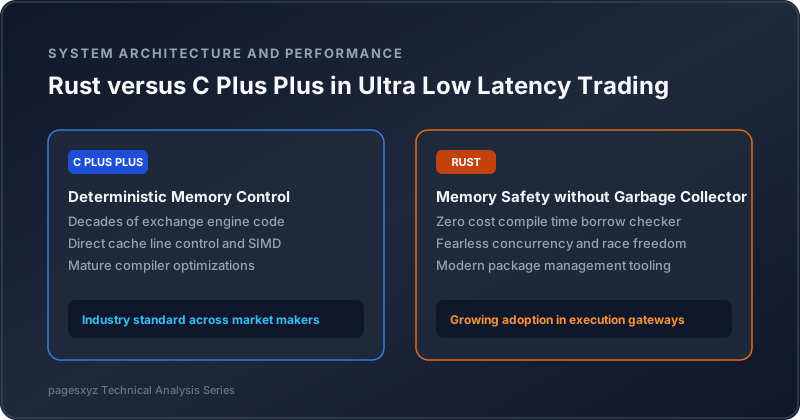
C Plus Plus offers bare metal performance and complete control over system memory layout. Developers can align data structures directly with CPU cache lines. They can eliminate heap allocations entirely inside hot execution loops. Modern C Plus Plus standards like C Plus Plus 20 and C Plus Plus 23 introduce concepts and modules that enhance code quality.

The Pitch for Rust Memory Safety Without Latency Penalties

The primary challenge with C Plus Plus remains undefined behavior. Memory corruption bugs such as use after free and buffer overflows can remain hidden during development. In high frequency trading an undetected memory bug during live market volatility can result in catastrophic financial losses.

Rust addresses this vulnerability through its compile time ownership model and borrow checker. The compiler enforces thread safety and memory safety guarantees without introducing a garbage collection runtime. This makes Rust uniquely suited for deterministic latency profiles.

Tail Latency and Cache Locality Benchmarks

Tail latency is the true test for any algorithmic trading engine. An engine that averages fifty nanoseconds per message but spikes to ten microseconds during packet bursts will miss critical market fills. Rust zero cost abstractions generate assembly that matches optimized C Plus Plus code in tight loops. Cache line alignment and SIMD vectorization work reliably in both languages.

Practical Trade Offs in Exchange Connectivity

Adopting Rust across an established market maker involves practical engineering trade offs. Major exchanges like CME and Nasdaq provide native client connectivity libraries written in C and C Plus Plus. Integrating Rust with legacy C APIs requires foreign function interface wrappers that require careful maintenance.

Where Trading Firms Are Deploying Rust Today

Today leading trading desks adopt a hybrid architecture. Core feed handlers and existing network cards often remain in C Plus Plus. Meanwhile new execution gateways risk engines and crypto liquidity routers are frequently built from scratch in Rust. Software engineers entering the quantitative trading industry benefit greatly from mastering both languages.

Advertisementpagesxyz Sponsor Network
ML
Marcus Lindqvist12+ Years in Ultra-Low Latency C++ & High-Frequency Trading Systems
Staff Systems Engineer & Low-Latency Architect

Engineers high-throughput market-making infrastructure, kernel-bypass network drivers (Solarflare EF_VI), lock-free data structures, and hardware-accelerated FPGA trading loops.

View full bio & editorial board profile →

Explore Related Career & Technical Prep

📚
Study Guides

Full curriculums for quant finance, algorithms, stochastic calculus, and AI.

💡
Interview Vault

Real probability puzzles and financial math questions with worked solutions.

🏛️
Firm Directory

Hiring criteria, compensation benchmarks, and profiles of top market makers.