ppagesxyzPlatform
JobsStudy GuidesFreeInterview Vault2.8k+Research & BlogCompaniesResume Review
Post a Job
ppagesxyzInstitutional Platform

The independent career intelligence, university-grade curriculum, and interview preparation resource for quantitative researchers, algorithmic traders, and high-performance software engineers.

Editorial BoardContact SupportExplore Free Curriculums →

Career Preparation

  • Interview Question Vault (2.8k+)
  • Probability Puzzles & Proofs
  • Market & Financial Engineering
  • Trading Brain Teasers
  • Quant Resume Review Service

Study Curriculums

  • Quantitative Finance Guide
  • Artificial Intelligence Track
  • Machine Learning Track
  • Data Science Curriculum
  • Low-Latency Software Engineering

Technical Research

  • Rust vs C++ in HFT Systems
  • Alternative Data & ML Alpha
  • RL Execution & Liquidity
  • Garden Leave & Non-Competes
  • Quant Salary & Bonus Guide
  • All Technical Articles & Guides

Firm Directory

  • Company Directory (450+)
  • Proprietary Trading Desks
  • Technology Organizations
  • Quant Startups & Market Makers
  • Post a Verified Opening

Trust & Legal

  • About & Technical Editorial Board
  • Editorial & Sourcing Policy
  • Privacy Policy (GDPR)
  • Terms of Use
  • Contact, Corrections & Privacy

Publisher & Editorial Standards

pagesxyz Media operates from Helsinki, Finland in compliance with European Union digital services standards. All curriculum tracks and worked solutions are authored and vetted by credentialed quantitative researchers and low-latency systems engineers.

Responsible Advertising & Disclosures

Advertising served through Google AdSense adheres strictly to Google Publisher Policies and EU GDPR consent frameworks. Display advertisements are clearly identified and do not influence curriculum recommendations or editorial rankings.

© 2026 pagesxyz Media. All rights reserved. Registered in Helsinki, Finland (EU).

Privacy Policy•Terms of Use•Editorial Guidelines•Contact
Home/Blog/Order Flow Toxicity and Volume Synchronized Probability of Toxicity

Order Flow Toxicity and Volume Synchronized Probability of Toxicity

AV
Dr. Alex Vance, PhD• Lead Quantitative Researcher & Technical Editor
•2026-10-24•Peer-Reviewed
Order Flow Toxicity and Volume Synchronized Probability of Toxicity
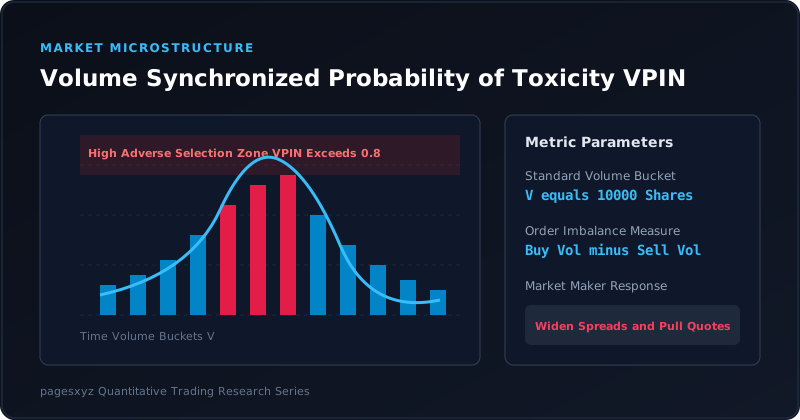
Visualizing informed volume spikes and real time adverse selection boundaries

The Nature of Adverse Selection in Electronic Markets

Automated market makers survive by earning the bid ask spread across liquid assets. However providing liquidity carries inherent risk known as adverse selection. Not all market participants trade for liquidity needs. Informed traders enter orders only when they possess superior information about impending price movement.

Why Traditional Time Based Volatility Fails

Traditional risk management models measure price volatility across fixed clock time intervals like five minute or hourly windows. In modern electronic markets this assumption breaks down. Markets operate in transaction time where periods of quiet trading alternate with sudden bursts of thousands of trades.

Measuring risk using fixed clock intervals causes algorithms to underestimate exposure during market crashes or aggressive institutional liquidations. A robust risk metric must synchronize directly with trading volume.

The Mechanics of Volume Bucketing in VPIN

Volume Synchronized Probability of Toxicity or VPIN addresses this flaw by dividing order flow into fixed volume buckets instead of clock time. A volume bucket fills when a predetermined number of shares or contracts execute across the exchange limit order book.

For each volume bucket the algorithm estimates trade direction by classifying buyer initiated and seller initiated volume. The absolute order imbalance between buyer and seller volume reveals the concentration of informed trading activity.

How Market Makers React to Toxic Order Flow

When VPIN readings exceed normal historical thresholds the market maker detects incoming adverse selection. Informed counterparties are aggressively consuming posted liquidity on one side of the book.

Automated quoting engines respond in milliseconds by widening quoted spreads skewing pricing towards the informed direction or pulling passive quotes entirely. This automated self defense preserves capital during sharp market dislocations.

Implementation Insights for Quantitative Desks

Implementing VPIN in high frequency production requires streaming tick processing engines capable of millisecond volume aggregations. Desks that successfully integrate volume synchronized metrics protect their trading books while maintaining high profitability across choppy market conditions.

Advertisementpagesxyz Sponsor Network
AV
Dr. Alex Vance, PhDPhD in Applied Mathematics (Stochastic Calculus & PDE Analysis)
Lead Quantitative Researcher & Technical Editor

Former quantitative researcher at proprietary market-making firms. Specializes in stochastic volatility calibration, order flow microstructure, and mathematical foundations of trading interviews.

View full bio & editorial board profile →

Explore Related Career & Technical Prep

📚
Study Guides

Full curriculums for quant finance, algorithms, stochastic calculus, and AI.

💡
Interview Vault

Real probability puzzles and financial math questions with worked solutions.

🏛️
Firm Directory

Hiring criteria, compensation benchmarks, and profiles of top market makers.