ppagesxyzPlatform
JobsStudy GuidesFreeInterview Vault2.8k+Research & BlogCompaniesResume Review
Post a Job
ppagesxyzInstitutional Platform

The independent career intelligence, university-grade curriculum, and interview preparation resource for quantitative researchers, algorithmic traders, and high-performance software engineers.

Editorial BoardContact SupportExplore Free Curriculums →

Career Preparation

  • Interview Question Vault (2.8k+)
  • Probability Puzzles & Proofs
  • Market & Financial Engineering
  • Trading Brain Teasers
  • Quant Resume Review Service

Study Curriculums

  • Quantitative Finance Guide
  • Artificial Intelligence Track
  • Machine Learning Track
  • Data Science Curriculum
  • Low-Latency Software Engineering

Technical Research

  • Rust vs C++ in HFT Systems
  • Alternative Data & ML Alpha
  • RL Execution & Liquidity
  • Garden Leave & Non-Competes
  • Quant Salary & Bonus Guide
  • All Technical Articles & Guides

Firm Directory

  • Company Directory (450+)
  • Proprietary Trading Desks
  • Technology Organizations
  • Quant Startups & Market Makers
  • Post a Verified Opening

Trust & Legal

  • About & Technical Editorial Board
  • Editorial & Sourcing Policy
  • Privacy Policy (GDPR)
  • Terms of Use
  • Contact, Corrections & Privacy

Publisher & Editorial Standards

pagesxyz Media operates from Helsinki, Finland in compliance with European Union digital services standards. All curriculum tracks and worked solutions are authored and vetted by credentialed quantitative researchers and low-latency systems engineers.

Responsible Advertising & Disclosures

Advertising served through Google AdSense adheres strictly to Google Publisher Policies and EU GDPR consent frameworks. Display advertisements are clearly identified and do not influence curriculum recommendations or editorial rankings.

© 2026 pagesxyz Media. All rights reserved. Registered in Helsinki, Finland (EU).

Privacy Policy•Terms of Use•Editorial Guidelines•Contact
Home/Blog/Kernel Bypass Networking and Solarflare EFVI in Algorithmic Trading

Kernel Bypass Networking and Solarflare EFVI in Algorithmic Trading

ML
Marcus Lindqvist• Staff Systems Engineer & Low-Latency Architect
•2026-10-24•Peer-Reviewed
Kernel Bypass Networking and Solarflare EFVI in Algorithmic Trading
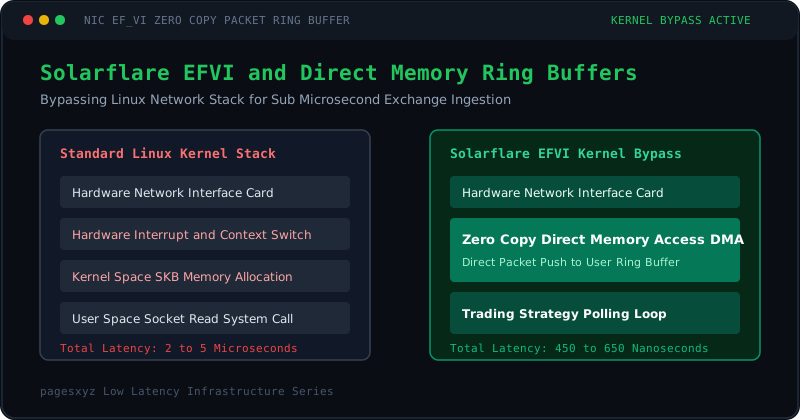
Hardware packet flow comparison between Linux kernel sockets and Solarflare EFVI

The Operating System Bottleneck in Modern Execution

In ultra low latency algorithmic trading every nanosecond spent inside operating system routines represents lost opportunity. Standard network programming on Linux relies on POSIX socket system calls. While these interfaces offer stability and broad hardware compatibility they introduce significant overhead during high throughput market bursts.

Understanding Kernel Traps and Context Switching

When an exchange market data packet hits a conventional network card the hardware triggers an electrical interrupt line. The CPU must immediately pause executing the active user thread save register states and switch into privileged kernel mode. The operating system kernel allocates a socket buffer structure copies payload bytes and signals the application thread through an event loop.

This context switch alone costs several microseconds. During fast market moves and economic news releases thousands of market updates flood the network interface card. The resulting interrupt storm saturates CPU cores and introduces massive latency variance across trades.

Direct Hardware Access Through Solarflare EFVI

Kernel bypass technology completely eliminates the operating system kernel from the critical network path. Solarflare network interface cards support the EFVI application programming interface. EFVI provides a lean user level interface directly to the physical network card ring buffers.

With EFVI the trading application maps packet memory buffers directly into user space memory using direct memory access DMA techniques. When an exchange multicasts a price quote update the network card hardware deposits the Ethernet frame directly into application memory without intermediate copies or operating system involvement.

Tight Polling Loops and Zero Copy Architecture

Algorithmic trading engines using EFVI execute dedicated busy polling loops pinned to isolated CPU cores. Instead of sleeping and waiting for kernel wake up notifications the core continuously inspects hardware completion event queues. The moment a packet arrives the parsing logic unpacks binary exchange protocols like ITCH or Simple Binary Encoding.

This zero copy architecture drops total packet ingestion latency from four microseconds down to under six hundred nanoseconds. The reduction in jitter allows automated market makers to cancel quotes ahead of stale fills.

Engineering Considerations and System Reliability

Developing kernel bypass applications demands disciplined systems engineering. Because the operating system is removed developers must manage ring buffer allocation packet drops and hardware timestamps manually. Despite the added complexity kernel bypass remains mandatory infrastructure across leading proprietary trading desks.

Advertisementpagesxyz Sponsor Network
ML
Marcus Lindqvist12+ Years in Ultra-Low Latency C++ & High-Frequency Trading Systems
Staff Systems Engineer & Low-Latency Architect

Engineers high-throughput market-making infrastructure, kernel-bypass network drivers (Solarflare EF_VI), lock-free data structures, and hardware-accelerated FPGA trading loops.

View full bio & editorial board profile →

Explore Related Career & Technical Prep

📚
Study Guides

Full curriculums for quant finance, algorithms, stochastic calculus, and AI.

💡
Interview Vault

Real probability puzzles and financial math questions with worked solutions.

🏛️
Firm Directory

Hiring criteria, compensation benchmarks, and profiles of top market makers.