ppagesxyzPlatform
JobsStudy GuidesFreeInterview Vault2.8k+Research & BlogCompaniesResume Review
Post a Job
ppagesxyzInstitutional Platform

The independent career intelligence, university-grade curriculum, and interview preparation resource for quantitative researchers, algorithmic traders, and high-performance software engineers.

Editorial BoardContact SupportExplore Free Curriculums →

Career Preparation

  • Interview Question Vault (2.8k+)
  • Probability Puzzles & Proofs
  • Market & Financial Engineering
  • Trading Brain Teasers
  • Quant Resume Review Service

Study Curriculums

  • Quantitative Finance Guide
  • Artificial Intelligence Track
  • Machine Learning Track
  • Data Science Curriculum
  • Low-Latency Software Engineering

Technical Research

  • Rust vs C++ in HFT Systems
  • Alternative Data & ML Alpha
  • RL Execution & Liquidity
  • Garden Leave & Non-Competes
  • Quant Salary & Bonus Guide
  • All Technical Articles & Guides

Firm Directory

  • Company Directory (450+)
  • Proprietary Trading Desks
  • Technology Organizations
  • Quant Startups & Market Makers
  • Post a Verified Opening

Trust & Legal

  • About & Technical Editorial Board
  • Editorial & Sourcing Policy
  • Privacy Policy (GDPR)
  • Terms of Use
  • Contact, Corrections & Privacy

Publisher & Editorial Standards

pagesxyz Media operates from Helsinki, Finland in compliance with European Union digital services standards. All curriculum tracks and worked solutions are authored and vetted by credentialed quantitative researchers and low-latency systems engineers.

Responsible Advertising & Disclosures

Advertising served through Google AdSense adheres strictly to Google Publisher Policies and EU GDPR consent frameworks. Display advertisements are clearly identified and do not influence curriculum recommendations or editorial rankings.

© 2026 pagesxyz Media. All rights reserved. Registered in Helsinki, Finland (EU).

Privacy Policy•Terms of Use•Editorial Guidelines•Contact
Home/Blog/From Academia to Quantitative Trading How PhDs Break In

From Academia to Quantitative Trading How PhDs Break In

SJ
Sarah Jenkins• Head of Quantitative Talent & Career Strategy
•2026-10-24•Peer-Reviewed
From Academia to Quantitative Trading How PhDs Break In
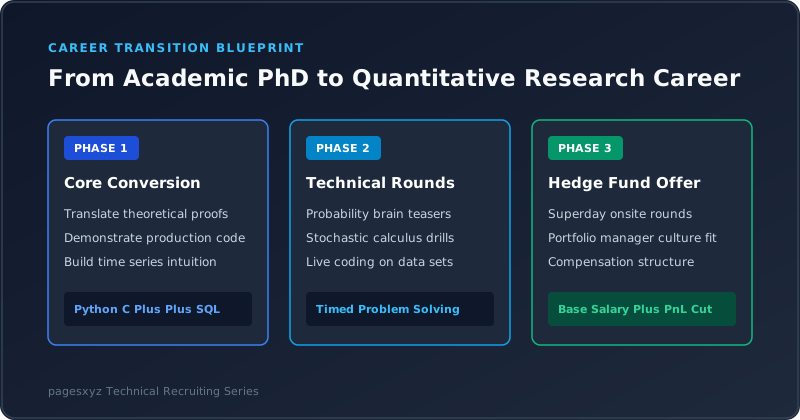
Three phase transition blueprint from academic doctoral research to quantitative hedge fund roles

Why Trading Firms Value Academic Doctoral Training

Top quantitative hedge funds and proprietary trading shops consistently hire PhD graduates from physics mathematics computer science and electrical engineering. What makes doctoral candidates attractive is not knowledge of financial jargon but proven ability to formulate hypotheses analyze messy empirical data and solve unsolved problems under uncertainty.

Unlearning Academic Habits That Slow You Down

The primary hurdle for academic researchers entering industry is adjusting to commercial time horizons. In academic research a project may take three years to yield a publishable journal paper. In quantitative trading research cycles operate in weeks or months.

Academic perfectionism must give way to pragmatic statistical validation. A model that achieves fifty five percent directional accuracy with controlled downside risk is far more valuable than an intricate mathematical theory that cannot survive transaction costs.

Upgrading Software Engineering to Production Standards

Many academics write exploratory scripts that work only on personal workstations. In professional quantitative finance your research code must integrate with high performance data pipelines and backtesting frameworks.

Candidates must master vectorized Python libraries and demonstrate familiarity with clean C Plus Plus or Rust implementations. Writing modular testable code with Git version control and proper documentation immediately distinguishes top applicants.

Preparing for Technical Interviews and Probability Drills

Quantitative research interviews heavily evaluate foundational probability statistics and mental agility. Expect rigorous questions covering Markov chains stochastic calculus linear algebra conditioning and combinatorial puzzles under timed interview conditions.

Practice working through classic brain teasers on a whiteboard while verbalizing your reasoning clearly. Interviewers assess your thought process and response to hints just as much as the final mathematical answer.

Evaluating Offer Packages and Research Desk Culture

Compensation in quantitative finance differs fundamentally from academic salaries. Total compensation consists of a competitive base salary alongside performance bonuses tied to trading desk profitability. Finding a team with transparent mentoring and collaborative research culture ensures long term career growth.

Advertisementpagesxyz Sponsor Network
SJ
Sarah JenkinsEx-Hedge Fund & Prop Trading Talent Partner
Head of Quantitative Talent & Career Strategy

Has advised hundreds of quantitative researchers, algorithmic traders, and systems developers through top-tier hiring pipelines, resume screenings, compensation negotiations, and non-compete agreements.

View full bio & editorial board profile →

Explore Related Career & Technical Prep

📚
Study Guides

Full curriculums for quant finance, algorithms, stochastic calculus, and AI.

💡
Interview Vault

Real probability puzzles and financial math questions with worked solutions.

🏛️
Firm Directory

Hiring criteria, compensation benchmarks, and profiles of top market makers.